The modern Australian workplace has undergone a massive transformation over the past few years, moving away from temporary remote setups to established, long-term operational strategies. According to the Australian Bureau of Statistics, as of August 2025, 36.2 percent of employed Australians regularly work from home. This confirms that hybrid arrangements have stabilised as a permanent operational standard. A recent report by the Australian HR Institute (AHRI) also highlights that over 80 percent of employers expect hybrid work to either increase or remain stable in the near future. With 69 percent of local employers currently offering structured hybrid work arrangements, businesses must now focus on building a seamless tech environment that supports workers regardless of their physical location.
Achieving Meeting Equity in the Modern Office
One of the primary challenges businesses face today is the digital divide between in-office and remote staff. The same AHRI report noted that 57 percent of employers cite a feeling of disconnection between colleagues as the primary disadvantage of hybrid models. To combat this, modern office design has heavily shifted toward the concept of meeting equity. This means ensuring that remote participants have the same visual and auditory presence in a meeting as those sitting physically in the room.
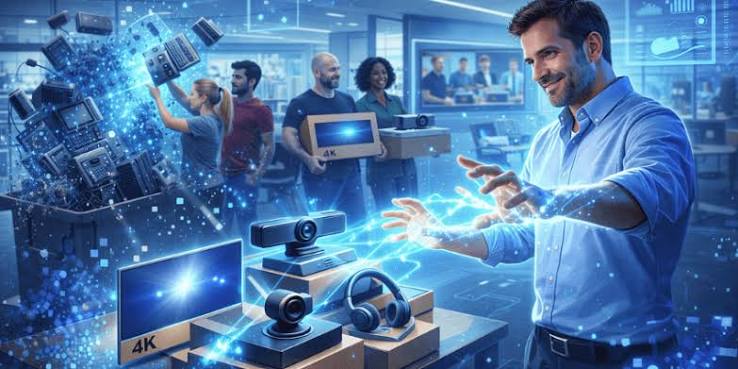
Establishing this equal footing requires moving away from outdated boardroom setups. Upgrading your physical workspace with reliable video conferencing equipment is an essential step to eliminate audio-visual friction between in-office and remote team members. By selecting modular, adaptable hardware, organisations can quickly scale their multi-purpose spaces up or down to suit varying room sizes and meeting types. This flexibility allows businesses to transform small huddle rooms or large executive suites into fully connected collaboration hubs at a moment’s notice.
Smart Cameras and Next-Generation AI
Offices are increasingly adopting platform-driven designs where physical hardware is specifically chosen to integrate natively with collaborative ecosystems like Microsoft Teams or Zoom. This shift is driving rapid advancements in meeting hardware, specifically aimed at making virtual interactions feel more natural and secure. Industry experts frequently point out that traditional ceiling-mounted or high-wall cameras create a sharp, downward angle that breaks natural eye contact.
To resolve these technical awkwardness issues, businesses are turning to highly advanced, eye-level solutions. Some of the most valuable tech upgrades for hybrid rooms now include:
- Centre-of-table cameras: These devices work alongside front-of-room screens to present a continuous, head-on view of everyone, ensuring remote workers are not just looking at the side of in-person attendees’ faces.
- AI smart composition and framing: Modern video bars use built-in artificial intelligence to instantly detect the active speaker. The technology automatically crops and frames the video feed without the need for manual remote controls.
- Cross-platform AI assistants: Next-generation hardware often features connected AI tools that can automatically handle live translations, document retrieval, and meeting summaries directly from the room system.
- Real-time deepfake detection: As corporate security concerns evolve into 2026, premium setups are beginning to integrate real-time video and audio deepfake detection. This cutting-edge security measure alerts participants to digital tampering during sensitive business calls, ensuring that confidential corporate data remains protected.
Software Ecosystems and Digital Well-Being
While high-quality physical devices form the foundation of a modern workspace, they must be paired with effective software to maintain team productivity and security. Managing a distributed workforce often requires clear digital infrastructure and streamlined workflows. Implementing robust employee monitoring software alongside your communication tools can help leaders track productivity metrics transparently while keeping cross-platform integration seamless.
Beyond productivity tracking, the human element of virtual software ecosystems is incredibly important. Fostering a genuine sense of connection is vital for employee retention and satisfaction in distributed teams. Providing staff with fully interactive, high-quality virtual meeting experiences has a direct impact on their mental well-being. A recent Harvard Business School study found that directly following interactive virtual experiences, positive affect and feelings of connectedness increased while loneliness decreased. This highlights that facilitating capable audio-visual setups is not just an IT requirement but a critical part of supporting remote worker well-being.
As the landscape of remote work continues to mature, standardising your technology infrastructure is the best way to future-proof your business. By investing in modern hardware, deploying AI-driven camera systems, and integrating effective workflow software, you can create a truly seamless hybrid work environment. When companies prioritise meeting equity alongside robust digital platforms, they build a more resilient and inclusive company culture. Empowering your team with the right tools ensures that collaboration remains strong, regardless of where your employees choose to log in each morning.