Many people have ideas for songs long before they have the time, software, or production skills to build those ideas into something listenable. That gap is exactly where an AI Music Generator becomes useful. The real problem is not imagination. It is translation. A creator may know the mood, the pace, the chorus energy, or the lyrical theme, but still struggle to turn those instincts into a finished track without opening a full digital audio workstation or hiring outside help.
That is why the current wave of music AI platforms matters. They do not remove judgment, taste, or revision from the process. They reduce the friction between having a musical direction and hearing a first working result. In my testing, the best tools are not always the ones with the loudest claims. They are the ones that make it easier to move from vague intention to usable output with the least wasted effort.
Why This Category Feels More Useful Now
A few years ago, most AI music tools felt like experiments. They could generate interesting fragments, but they often struggled to produce something coherent enough for real use. That has started to change. The stronger platforms now frame music generation as a workflow rather than a novelty. They let users begin with a short prompt, custom lyrics, or a style description, then return a track that can at least serve as a serious draft.
For everyday creators, this shift matters. A short-form video editor may need a fast instrumental bed. A marketer may need a custom hook for a campaign. A songwriter may want to test whether an idea works better as a cinematic ballad or a lighter pop track. In each case, speed matters, but so does controllability.
How I Ranked These Five Platforms
Creative Direction Matters More Than Raw Hype
I ranked these platforms based on what a normal user is likely to care about first:
- How easy it is to start
- Whether lyrics and prompts are both supported
- How flexible the workflow feels
- Whether the output seems practical for repeated use
- How clearly the platform communicates its strengths
This is not a scientific benchmark. It is a practical ranking shaped by public product positioning and what appears most useful for actual creators.
A Good Tool Must Survive Repetition
The first successful generation is not the hard part. The harder question is whether a platform still feels helpful on the third project, the seventh revision, or the next campaign with a different tone. In my observation, that is where some tools begin to feel like toys, while others start to behave more like repeatable creative systems.
The Five Platforms That Stand Out Most
1. ToMusic
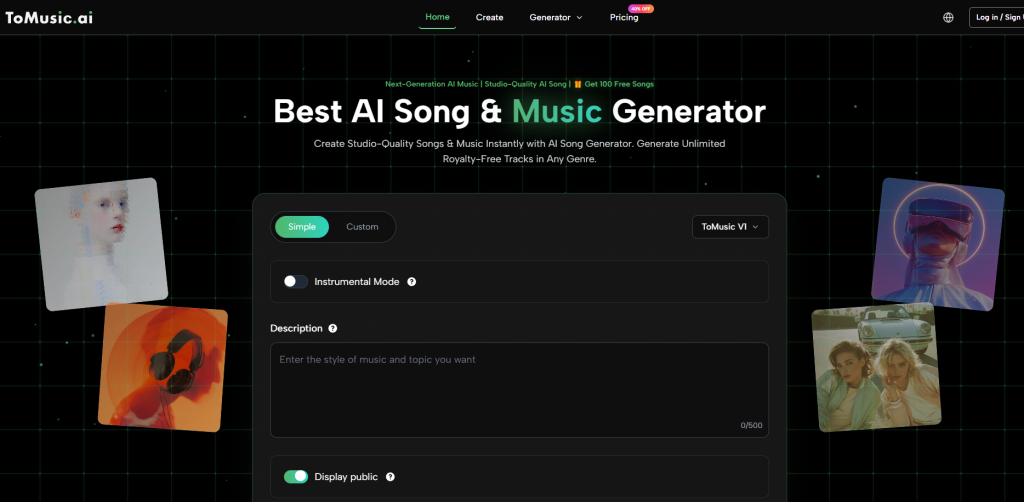
ToMusic takes the top spot because its public workflow feels especially clear for people who want to generate songs from either descriptions or custom lyrics. It presents music creation as a practical sequence rather than an abstract AI demo. That matters because many users do not want to study a complex production environment before they hear anything useful.
The platform appears strongest when you want a direct path from prompt or lyric sheet to a complete musical result. Publicly, it emphasizes multiple model versions, genre flexibility, vocal generation, instrumental generation, and a built-in library for managing outputs. In my testing and reading of its public pages, that combination gives it a more rounded feel than tools that mainly focus on a single style of generation.
2. Suno
Suno remains one of the most visible names in this category for a reason. It is fast, easy to understand, and often effective at producing polished first impressions. For users who want quick song drafts with strong surface appeal, it can be a compelling option.
Its strength is accessibility. A person with little music background can usually understand the starting point immediately. The tradeoff is that highly polished outputs do not always equal deep control. For some users, that is perfectly fine. For others, especially those who want to guide structure more carefully, the workflow may feel a little more interpretive than precise.
3. Udio
Udio feels more attractive to users who care about nuance, style texture, and iterative refinement. In my observation, it often appeals to people who want more than a one-click result. It gives the impression of a platform built for users who enjoy shaping generations rather than only receiving them.
That makes it strong for experimentation, but also slightly less immediate for users who just want a quick song draft and nothing more. The upside is creative depth. The downside is that some users may need more patience to get exactly what they want.
4. Boomy
Boomy earns its place because it still makes the idea of instant song creation approachable. Its public positioning is especially friendly to beginners who want to create music quickly without learning a complex system first.
The main advantage is low friction. The limitation is that ease sometimes comes with a narrower feeling of control. For users who want rapid background tracks or simple starting points, that may be enough. For users seeking stronger lyric-driven song shaping, it may feel more lightweight than the leaders above it.
5. AIVA
AIVA remains important because it represents a different branch of AI music generation. It has long been associated with structured composition and style-based music creation, which can make it appealing for users thinking in terms of scoring, instrumental composition, or more formal music-building logic.
That said, for the average modern creator who wants fast prompt-to-song generation, it can feel less immediate than newer consumer-facing platforms. Its value is real, but its strongest use case may not be identical to the quick social-content workflow that now drives much of the category.
What Makes ToMusic The Most Balanced Choice
It Supports More Than One Creative Entry Point
One reason ToMusic stands out is that it does not force every user into the same starting behavior. Some people think in moods and genres. Others think in lyrics. Others already know the structure they want and simply need a generation engine to test it. A platform becomes more useful when it can accept multiple kinds of creative intent without making the user reshape their thinking first.
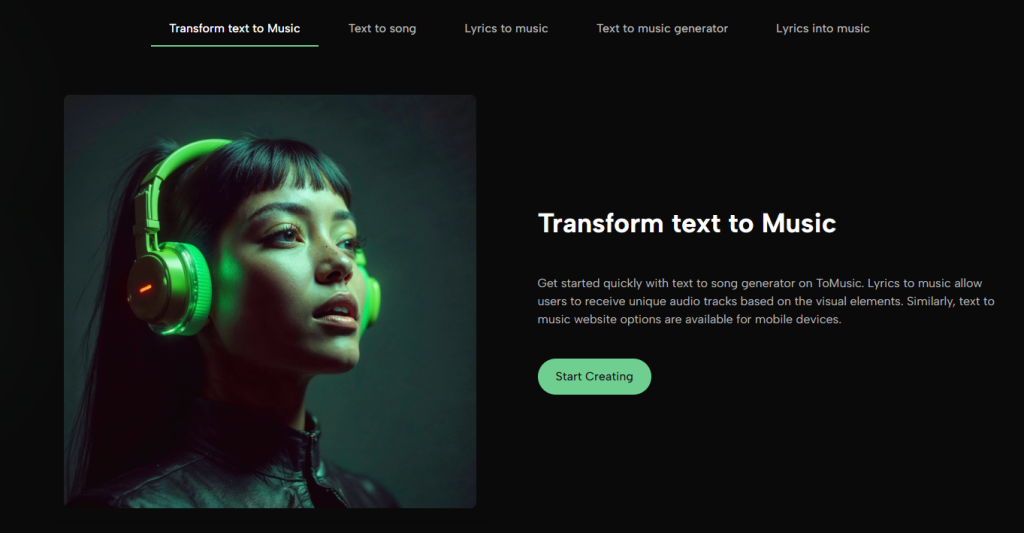
That is where Text to Music becomes especially valuable. It gives non-musicians a straightforward way to describe the kind of result they want, while still leaving room for users who already have lyrics or a more specific concept in mind.
Its Public Workflow Feels Productive
The public product structure appears to revolve around a simple sequence:
Choose Your Input Starting Method
Users can begin from a descriptive prompt or custom lyrics. That is important because not every creator starts from the same material.
Pick A Model And Direction
The platform publicly presents multiple model options, suggesting that different generation styles or strengths are available depending on the creative goal.
Generate And Review The Result
Instead of treating the first output as final, the platform frames generation as the beginning of selection and refinement.
Save Outputs Inside A Working Library
The built-in music library matters more than it first appears to. Many platforms can generate a song. Fewer feel organized enough for repeated use. When tracks, lyrics, and generation history are easier to revisit, the product feels less like a novelty and more like a real workspace.
That Library Layer Changes Repeat Usage
A strong library system helps creators compare attempts, revisit ideas, and keep projects from turning into disposable fragments. For people generating multiple drafts across campaigns or content series, that is not a minor detail. It is part of what makes a tool operationally useful.
Clear Comparison Across The Five Platforms
| Platform | Strongest Use Case | Best For | Main Limitation |
| ToMusic | Prompt and lyric-based song creation | Users wanting flexibility and a guided workflow | Results still depend on input quality |
| Suno | Fast polished song drafts | Beginners and fast content creation | Control can feel less exact in some cases |
| Udio | Detailed experimentation and refinement | Users who enjoy iterative shaping | Can feel less immediate for casual users |
| Boomy | Fast simple music generation | Beginners needing low friction | May feel lighter on deep customization |
| AIVA | Structured composition and style-driven music | Instrumental and composition-focused users | Less direct for prompt-to-song users |
Where These Platforms Help Most In Practice
Music AI is easiest to understand when tied to real workflows. A creator with a short-video channel may not need a masterpiece. They may need three plausible options by this afternoon. A founder may need a custom intro track that sounds specific enough to avoid generic stock music. A writer with finished lyrics may want to hear whether their words land better as indie pop, cinematic folk, or something more electronic.
In those cases, speed is not the only value. Interpretability is also valuable. The user wants to understand why a tool gave them a certain result and whether they can steer the next one more effectively. That is why workflow clarity matters as much as sound quality.
Why Caution Still Makes Sense
It would be too easy to talk about this category as if every good output were fully intentional. That is not how these tools work. Prompting still matters. Lyrics still matter. Taste still matters. A platform can reduce execution difficulty, but it cannot replace judgment.
In my testing, the first result is often useful as a direction rather than a destination. Some songs need multiple attempts before the pacing, tone, or vocal feel starts to align with the original idea. That is not necessarily a flaw. It is part of using generative systems responsibly. The better mindset is to treat these tools as fast collaborators, not perfect executors.
What This Ranking Really Suggests
The most important takeaway is not that one platform wins forever. It is that different tools now serve different creative temperaments. Some prioritize speed. Some reward patience. Some lean toward easy song generation. Others fit more structured composition.
Right now, ToMusic feels like the most balanced option in this five-platform group because it combines accessible entry points, lyric support, model variety, and project organization in a way that seems genuinely practical. That balance matters. The best creative tools are rarely the ones that sound most impressive in a headline. They are the ones that make good work easier to begin, easier to repeat, and easier to manage when the next idea arrives.