Artificial intelligence continues to reshape the way companies operate, compete, and grow. As businesses move deeper into the digital age, machine learning has become one of the most important technologies driving innovation. From customer service and marketing to cybersecurity and data analysis, AI is helping organizations make smarter decisions and improve efficiency. In 2026, machine learning is expected to become even more advanced, creating new opportunities for businesses of all sizes.
For technology-focused companies and digital solution providers like Cliffmar Tech, understanding these emerging trends is essential for staying ahead of competitors. Businesses that recognize and adopt the right AI technologies can improve productivity, reduce costs, and deliver better experiences to customers. The following machine learning trends are expected to have a major impact on industries throughout 2026 and beyond.
Smarter Generative AI for Business Operations
Generative AI has already transformed content creation, software development, and customer communication. In 2026, businesses will move beyond simple text generation and begin using more advanced AI systems that can create reports, analyze large datasets, generate code, and support complex business workflows. These tools will help teams complete tasks faster while maintaining high levels of accuracy and consistency.
Organizations are increasingly integrating generative AI into everyday operations rather than treating it as a standalone technology. Customer support teams can use AI-powered assistants to handle inquiries, while marketing departments can generate personalized campaigns based on customer behavior. As machine learning models become more reliable, businesses will rely on them to streamline operations and improve decision-making across multiple departments.
AI-Powered Predictive Analytics Becoming More Accurate
Predictive analytics has been a valuable business tool for years, but advances in machine learning are making predictions more precise than ever. Modern AI systems can process vast amounts of structured and unstructured data, helping companies identify patterns that would be difficult for humans to detect. This allows businesses to forecast customer demand, market trends, and operational risks with greater confidence.
In 2026, predictive analytics will play a larger role in strategic planning. Retail companies can anticipate buying trends, healthcare organizations can predict patient needs, and financial institutions can identify potential risks before they become serious problems. Improved prediction accuracy will help organizations allocate resources more effectively, reduce waste, and create better long-term business strategies powered by intelligent data analysis.
Edge AI Expanding Across Industries
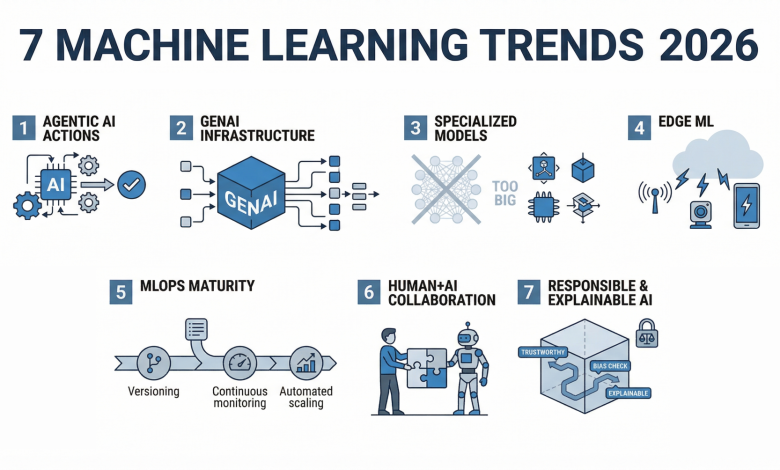
Edge AI refers to machine learning models that process data directly on devices rather than relying entirely on cloud computing. This approach reduces latency, improves response times, and enhances privacy because data can be analyzed closer to where it is generated. As connected devices continue to grow in popularity, edge computing and AI will become increasingly important for businesses.
Manufacturing facilities, smart cities, healthcare providers, and transportation companies are expected to benefit significantly from edge AI solutions. Real-time decision-making can improve equipment monitoring, traffic management, and patient care without depending on constant cloud connectivity. Businesses that adopt edge AI can gain faster insights while reducing bandwidth costs and improving operational efficiency in environments where speed is critical.
Responsible AI and Ethical Machine Learning
As AI becomes more powerful, organizations are paying greater attention to responsible development and ethical use. Consumers, regulators, and business leaders increasingly expect transparency in how machine learning systems collect, process, and use data. Companies that fail to address these concerns may face reputational damage, compliance issues, and loss of customer trust.
In 2026, responsible AI practices will become a core part of business strategy. Organizations will invest in explainable AI systems that provide clearer reasoning behind automated decisions. Ethical machine learning frameworks will help reduce bias, improve fairness, and ensure compliance with evolving regulations. Businesses that prioritize transparency and accountability will build stronger relationships with customers while creating more sustainable AI initiatives.
Industry-Specific AI Solutions Gaining Momentum
General-purpose AI tools remain valuable, but many businesses are seeking machine learning solutions tailored to their specific industries. Industry-focused AI models can understand specialized terminology, regulations, and workflows more effectively than generic systems. This trend is driving demand for customized AI applications that solve unique business challenges.
Healthcare providers are using AI to assist with diagnostics and patient management, while logistics companies optimize delivery routes and inventory management through machine learning. Financial institutions rely on AI for fraud detection and risk assessment, and e-commerce brands use intelligent recommendation systems to improve customer experiences. The rise of industry-specific AI solutions will allow organizations to achieve better results by leveraging technology designed specifically for their operational needs.
Human-AI Collaboration in the Workplace
Rather than replacing employees, modern AI systems are increasingly designed to work alongside human teams. Businesses are discovering that the best results often come from combining human creativity, judgment, and experience with machine learning capabilities. This collaborative approach helps organizations maximize productivity while maintaining human oversight where it matters most.
In 2026, AI-powered workplace tools will assist employees with research, project management, data analysis, and routine administrative tasks. Workers can focus more on strategic thinking and problem-solving while AI handles repetitive processes. Companies that invest in employee training and AI literacy will be better positioned to create productive human-machine partnerships that drive innovation and long-term business growth.
AI-Driven Cybersecurity Becoming Essential
As cyber threats become more sophisticated, businesses need advanced solutions to protect sensitive information and digital assets. Traditional security systems often struggle to keep pace with rapidly evolving attack methods. Machine learning offers a powerful way to identify unusual activity, detect threats in real time, and respond more quickly to potential security incidents.
AI-driven cybersecurity platforms can continuously analyze network traffic, user behavior, and system activity to uncover hidden vulnerabilities. These systems learn from past attacks and adapt to emerging threats, making them increasingly effective over time. In 2026, organizations across all industries will invest heavily in AI-powered security solutions to strengthen defenses, minimize risks, and maintain customer trust in an increasingly connected world.
Conclusion
Machine learning is entering a new phase of growth, bringing exciting opportunities for businesses willing to embrace innovation. From smarter generative AI and predictive analytics to edge computing, ethical AI practices, and industry-specific solutions, the trends shaping 2026 demonstrate how deeply artificial intelligence is becoming integrated into modern business operations. Organizations that stay informed and adapt to these changes will be better prepared to compete in fast-moving digital markets.
For technology-focused businesses and digital innovators such as Cliffmar Tech, understanding emerging AI developments is more important than ever. Companies that strategically implement machine learning technologies can improve efficiency, strengthen cybersecurity, enhance customer experiences, and make more informed decisions. As AI continues to evolve, businesses that invest in the right tools, skills, and strategies today will be well-positioned for long-term success in the years ahead.